In May 2011, something strange appeared in a public square in Barcelona.
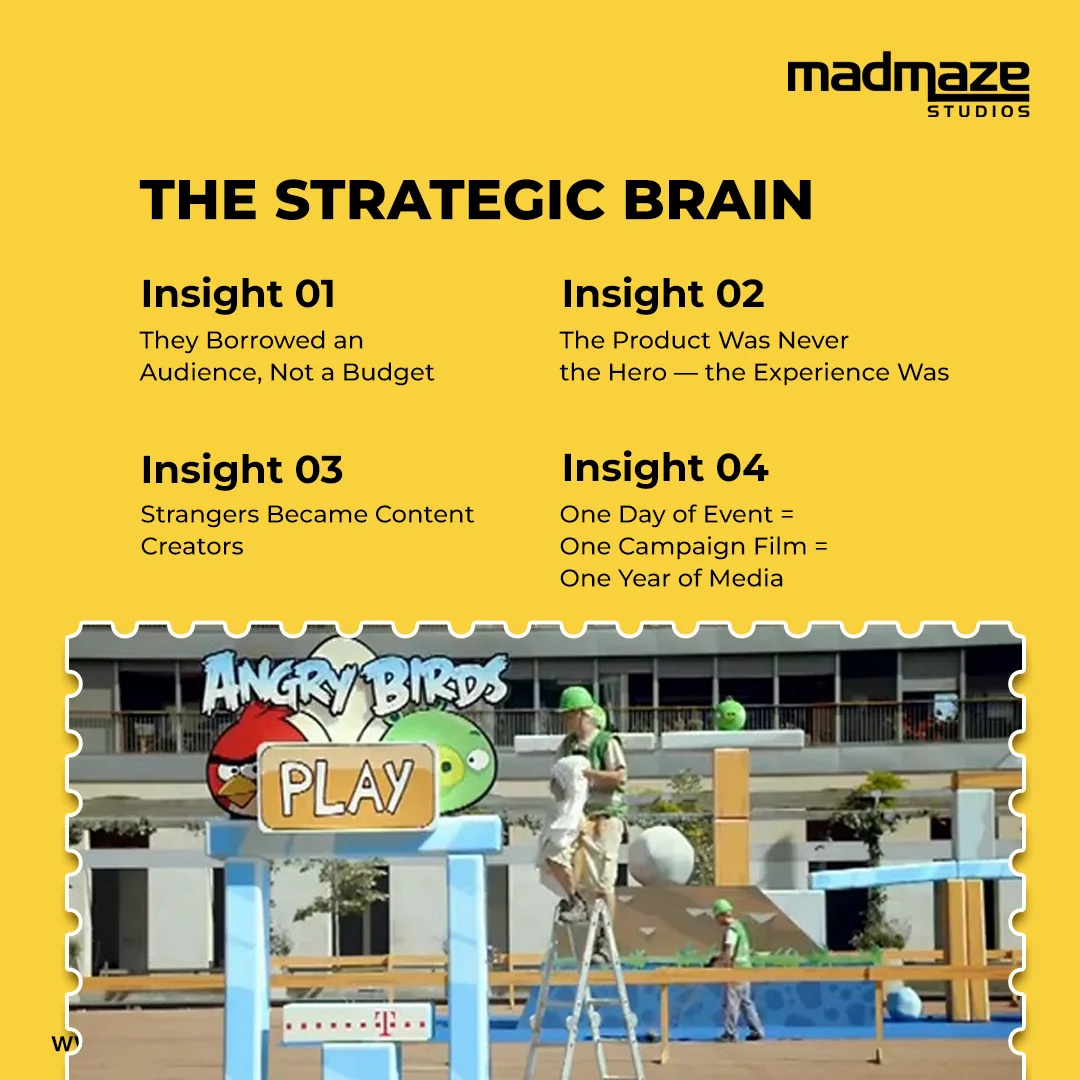
A giant screen. A life-size slingshot. Oversized bird props ready to fly. And a crowd of confused, then delighted passersby being handed smartphones and told: go ahead, fling.
What unfolded that day was one of the most talked-about pieces of experiential marketing in the early smartphone era, and a masterclass in how to make an entire city stop, stare, and want what you're selling.
T-Mobile, Rovio, and the smartphone gold rush
By early 2011, T-Mobile (the European consumer brand of Deutsche Telekom) had a problem that every telecom company shared: smartphones were everywhere, but convincing people to buy a data plan felt like a hard sell. It was functional. It was forgettable. It was category-speak.
Their solution wasn't to fight for attention. It was to find the most viscerally exciting thing people were already doing on their phones and blow it up to human scale.
That thing was Angry Birds.
Developed by Finnish company Rovio, Angry Birds had launched on iOS in December 2009 and exploded into a global obsession unlike anything mobile gaming had seen before. By the time T-Mobile was planning this campaign in early 2011, people were spending 200 million minutes a day playing Angry Birds worldwide. Paid downloads had crossed 10 million by October 2010.
By May 2012, the franchise would hit 1 billion cumulative downloads, the first mobile game series ever to do so. In 2011, Angry Birds wasn't just a game. It was pop culture.


Bringing Pixels to Pavements
T-Mobile's agency, Saatchi & Saatchi Italy , proposed a bold idea: create a fully playable, life-sized version of Angry Birds in a public square.
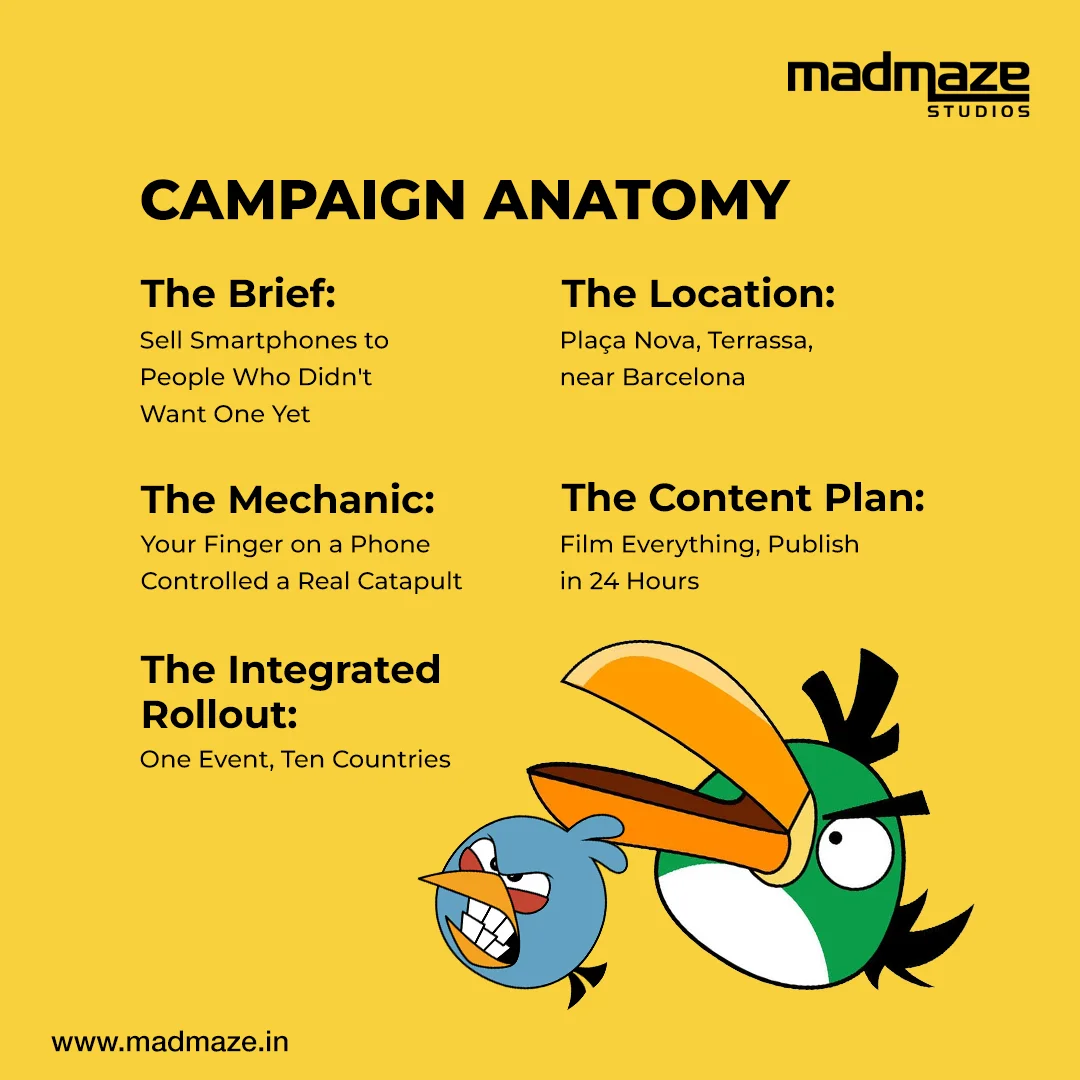
On May 11, 2011, a square in Barcelona became the world's biggest Angry Birds playground.
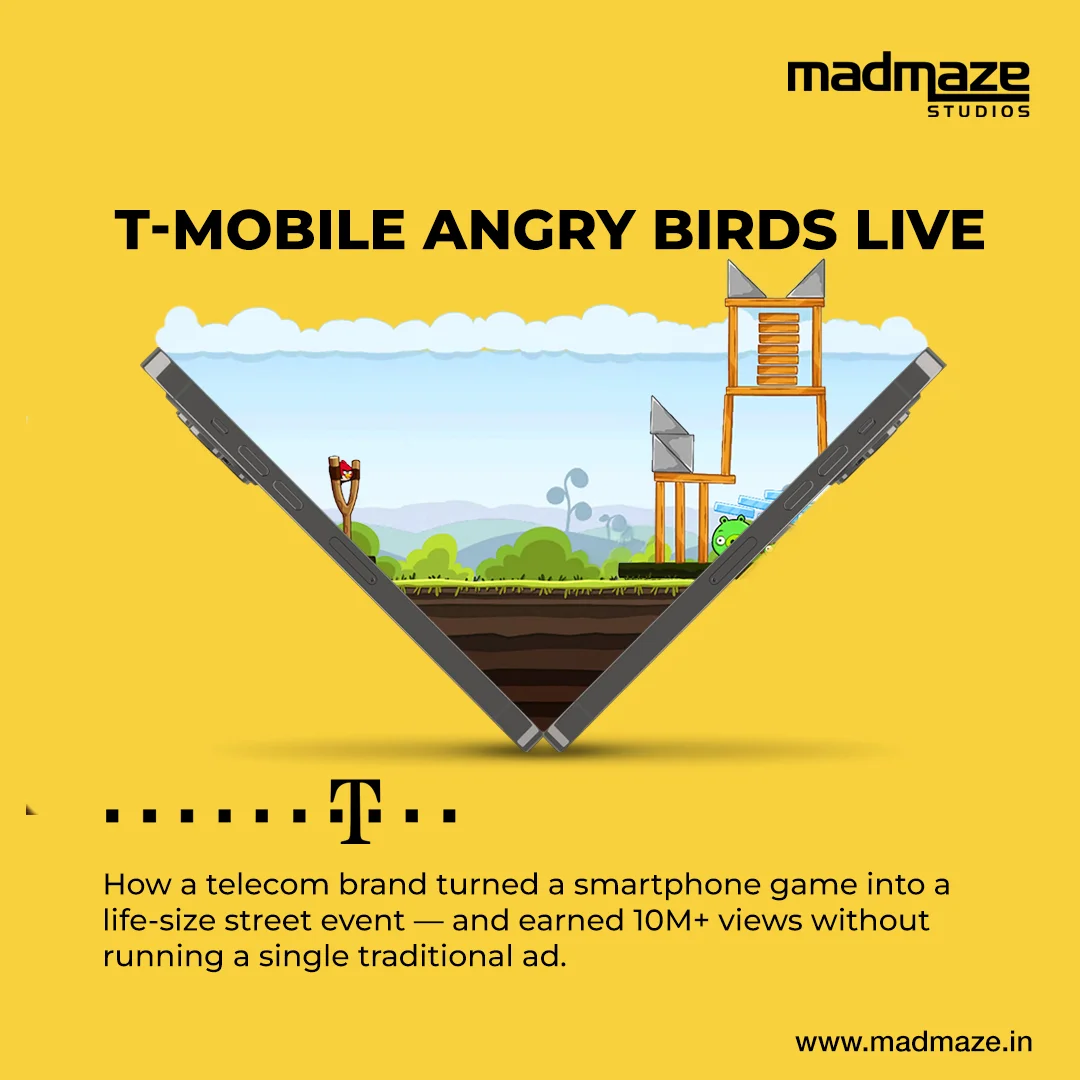
Passersby walked up to a kiosk and picked up a T-Mobile smartphone. They launched Angry Birds on the screen and from that moment, the game came to life at a scale no one expected.
Their on-screen gameplay was mirrored in real time on a giant digital display set up in the square. But here's the twist: when the virtual bird reached the edge of the screen, a real, life-size bird prop launched from behind the screen and flew across the square toward actual physical structures blocks, pigs, towers built to be knocked down.
A live band played the Angry Birds theme music throughout the event, making the square feel like you had walked into the game itself.
The slingshot wasn't pulled by hand. It was controlled entirely via the smartphone in your palm, which was exactly the point T-Mobile wanted to make. Look what a smartphone can do.
Timing is everything in Marketing
It's easy to look at this campaign and think "great stunt." But the strategy underneath it was precise.
T-Mobile's brief had specific, measurable commercial goals: increase Deutsche Telekom's revenue by €20 million year-on-year (Q3 2010 to Q3 2011) and raise smartphone-with-data-plan penetration by 10 percentage points within their core target audience of 14–35 year-olds in a single quarter.
That's not a brand awareness brief. That's a sales brief.
And the insight was smart: their target audience wasn't watching TV ads or reading telecom brochures. They were on their phones. Specifically, they were playing Angry Birds. So instead of telling young people that smartphones were fun, T-Mobile showed them at a scale that made the audience themselves want to share what they'd seen.
The whole event was captured on video and released on June 8, 2011, under T-Mobile's long-running "Life's for Sharing" brand platform, a campaign concept that had been running across 10 European markets since 2008, built around experiences worth sharing.
A Revenue Target Obliterated
The Barcelona event footage went viral before "going viral" was routine.
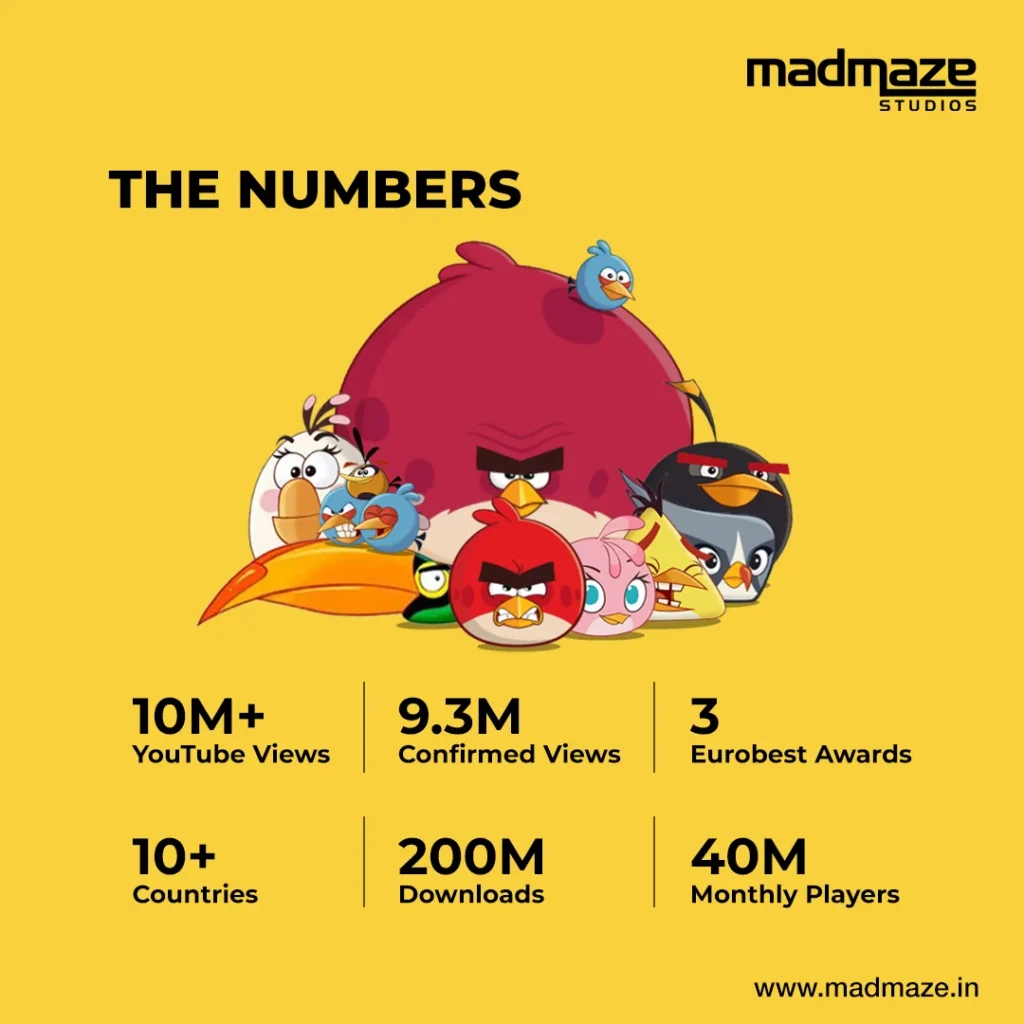
Within roughly two weeks of the video's release, it had crossed 5.8 million YouTube views. By the time the campaign had run its full course, the video accumulated over 9.3 million views, with some sources tracking it past 10 million total.
But the business results went far beyond views:
The campaign's success led T-Mobile to expand the concept into other European markets, proving that experiential marketing could drive both attention and tangible business growth.
2011 Eurobest Awards
At the 2011 Eurobest Awards, Europe's premier regional advertising festival, T-Mobile Angry Birds Live took home 3 Bronze awards:
The campaign has since been cited on WARC , Ads of the World , and AdForum as a benchmark for experiential and ambient marketing effectiveness.
T-Mobile walked into a Barcelona square with a smartphone, a giant slingshot, and a partnership with the most popular mobile game in the world and walked out having redefined what a telecom brand could look, feel, and behave like.
Madmaze Take: The Angry Birds Live campaign worked because it found the thing people already cared about deeply, daily, obsessively, and put a T-Mobile smartphone at the centre of that experience. No hard sell. No product feature list. Just pure, shareable joy. That's the blueprint: find your audience's obsession, earn your place in it honestly, and make it an experience to remember.